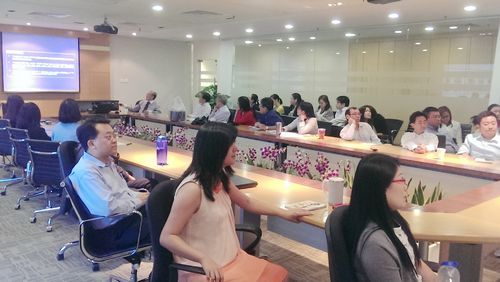
Anti-Money Laundering training conducted for all Singapore Branch Staff
On 24 September 2013,as part of the Bank's continuous efforts in enabling organizational learning, the Branch ran a training session on compliance matters to strengthen the staff's competence in this area.
It engaged an experienced compliance specialist to train all staff on due compliance work within the banking industry. The trainer, an advocate and solicitor with a specialization in the field of compliance, covered both the depth and breadth of the subject matter that includes criminalising tax crimes, reporting of tax crime, customer due diligence for trade finance transactions and handling Politically Exposed Persons (PEP).Participants were given an update on the latest developments in Anti-Money Laundering (AML) regulations where in May 2013, Singapore government announced that it would amend the relevant regulations to designate tax crime as predicate offences. And with effect from 1 July 2013, a broad range of serious tax crimes are designated as money laundering offences. With the designation, banks must apply the full suite of the AML measures to prevent the laundering of proceeds from serious tax crimes. If banks have reasonable ground to suspect customers’ assets are proceeds from serious foreign tax offences and are certain that foreign tax evasion is of a type which Singapore imposes, banks has to file a suspicious transaction report.
The specialist further explained the implications of the changes and give examples of tax offences to illustrate how the bank should investigate and conduct on-going monitoring on customers’ assets and transactions.
The scope of the training has also been broadened to include the Wolfsberg approach and trade finance principles when performing customer due diligence (CDD) on Letters of Credit transactions. Participants were taught the various techniques of trade-based money laundering and shown the different scenarios where manipulation of transactions could potentially conceal and mask the illegal movement of funds.
In some regimes where governmental politics is woven into the business practices, the definitions of PEP were also covered. Participants were made aware that in such a scenario, it is of paramount importance to establish the source of wealth and source of fund for customers involving PEP.
It is critical to stay ahead of the learning curve. The Bank will continue with its inexorable efforts to provide the staff with the necessary training to sharpen their skills and competencies so as to be able serve the markets better.